
drainage solutions: dry streams
- ElizabethFribush

- Mar 3, 2021
- 2 min read
Updated: Jul 20, 2021
To solve issues in your yard where storm water run-off is not adequately draining, one solution to include may be a dry stream. To determine the best drainage solutions for your property, we can start with assessing the situation, and then select the most appropriate solutions. See blog regarding Selecting Solutions for a Drainage Problem. :
Dry Streams:
This blog discusses dry streams, and future blogs will discuss French Drains and Rain Gardens. A dry stream is an excavated stream bed that allows for water to flow during and after rain storms. It can also include shallow pools that allow some water to be detained during and after a rainstorm, so that the water can slowly soak into the ground. If designed well, a dry stream can not only be functional, but can also be a beautiful addition to your garden!

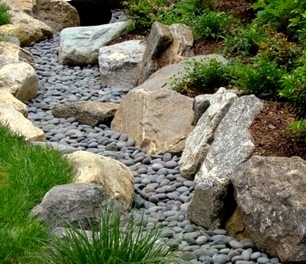
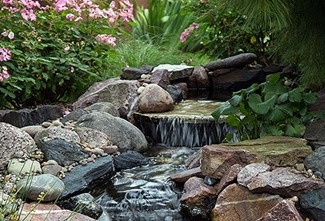
Dry Stream Design Goals (also applies to Circulating Waterfalls and Streams):
plan so that stream curves to work with existing contours of the land and to curve around existing trees and features. of course install in a location where a significant volume of existing storm drainage flows during and after large rain storms.
design to obscure the stream origin by starting behind trees or large plants and boulders; and end by plantings or slope
excavate entire stream so that it visually fits in for a natural look. Line the bottom of the stream bed with Soil Separator Gator Fabric. This fabric is only available at stone supply centers. It is secured with metal U staples, available at hardware stores.
install very large boulders half or 2/3rds buried and grouped at outside curves and at any waterfall, install small river stones at bottom. Create areas with shallow pools so that water is detained and will slowly soak into the ground. Flat rocks at lower edge of pools helps create waterfalls. If there is adequate existing slope for waterfalls, use several low height waterfalls such as typically 4-6 inch not higher. Never line stream edges with uniform size rocks. Use dark gray or black river rock and boulders for more natural look
add natural curves. Use masses of plantings to accentuate curves and tie into surrounding landscape for natural look
Avoid the following common mistakes for Dry Streams and Circulating Waterfalls and Streams:
don't line outer edge with same size rocks on surface (instead small river stones at bottom, very large boulders half buried with groupings at inside of curves and at outside. In nature large boulders get deposited at outside curves of streams)
don't install at surface grade (instead excavate minimum 6 to 8 inches for dry stream)
don't align the dry stream too straight (instead add curves that work with existing contours of the land and that curve around existing trees and features. The curving alignment of the stream both makes it look natural and also helps slow the velocity of the runoff during and after a storm)
don't leave out adjacent plantings (instead install drifts of low plantings to create natural look)
never outline stream with stones or randomly place boulders on surface (instead add larger boulders, half-buried, grouped at outer curves and waterfall, and use much smaller stones to line bottom)
do not install so that beginning and end are visible (instead obscure origin by starting behind trees or large plants and boulders; and end by plantings or slope)
Comments